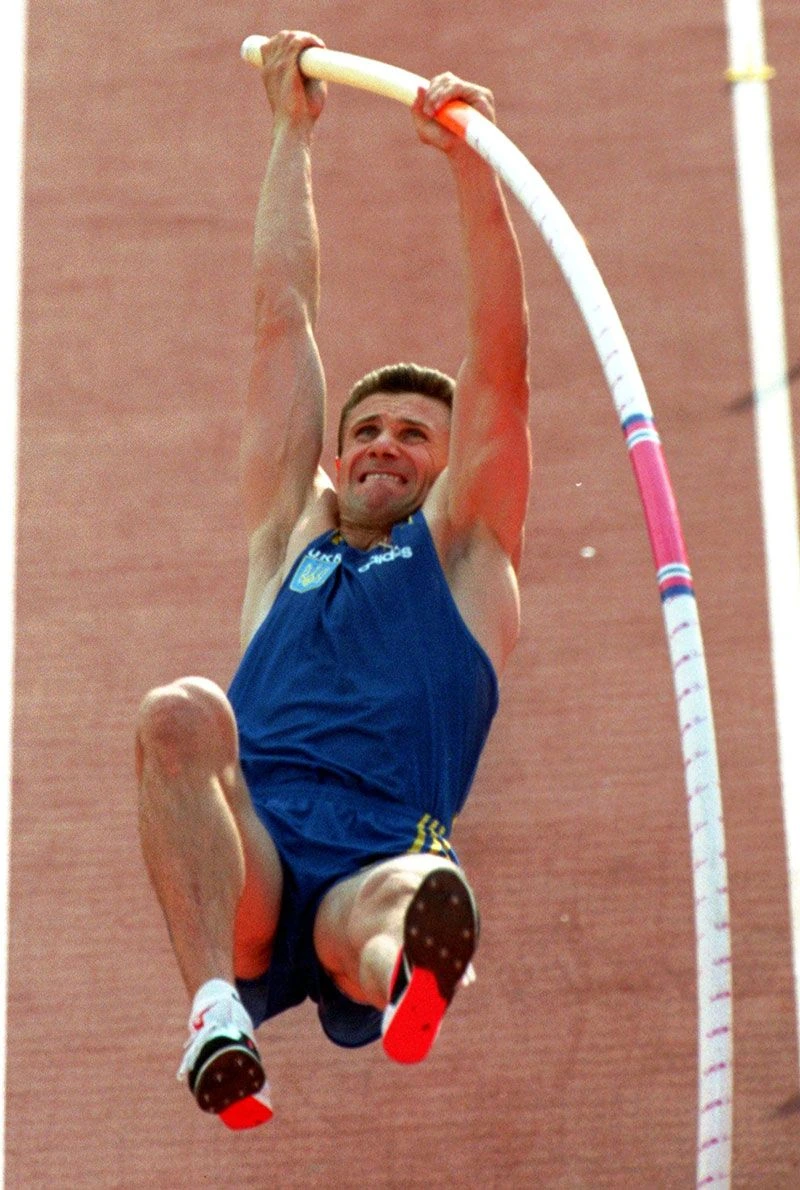
How Bubka built his wealth during his athletic career
Bubka's earning power during his active years came from two overlapping channels: prize money from competition and cash bonuses tied directly to world-record performances. On the prize side, the figures are striking even by today's standards. In September 1993, he won the IAAF Grand Prix overall title and pocketed a record $130,000 in prize money from that single event cycle alone. In a Los Angeles Times archive report on Sept. 11, 1993, Bubka and Sandra Farmer-Patrick won IAAF Grand Prix overall titles at a London track meet and each received a record $130,000 in prize money. That was a substantial payday for track and field in the early 1990s, and it illustrates just how commercially valuable his dominance made him.
The Nike contract, which he signed in 1992 after the collapse of the Soviet system that had previously controlled his earnings, is the most frequently cited wealth-building mechanism of his career. Nike paid him $40,000 for each world record he broke. Bubka broke the outdoor pole vault world record 17 times and the indoor record 18 times across his career. Secondary reporting suggests that those Nike bonuses alone totalled at least $600,000, though that figure is derived from public summaries rather than the contract itself. The strategy was deliberate: rather than clearing the bar by large margins, Bubka famously raised his own records by small increments, sometimes just one centimeter, maximizing the number of bonus-eligible performances. It is one of sport's most quoted examples of an athlete engineering their own income stream.
Beyond the Nike bonuses, elite athletes at Bubka's level also command appearance fees, which are payments made by meet organizers simply to guarantee a marquee name shows up at their event. These fees are rarely disclosed publicly, but for an athlete who held every major world record in his discipline throughout the late 1980s and 1990s, they would have been significant. His Olympic gold at the 1988 Seoul Games and six consecutive World Championship titles cemented his status as the sport's biggest draw, which gave him substantial leverage in those negotiations.

The Nike relationship was the anchor of Bubka's endorsement portfolio, and it went well beyond the per-record bonuses. In 1993, Nike featured him in a U.S. television commercial, which confirmed that the brand viewed him as a marketable global figure rather than just a performance asset. That level of media placement typically comes with a broader brand ambassador contract, though the financial terms were never publicly disclosed. For context, athlete endorsement deals of that era for globally recognized champions routinely ran into the low millions over multi-year terms.
Beyond Nike, Bubka's profile made him a natural candidate for other sponsorship arrangements common among elite track and field athletes: equipment partnerships, apparel deals, and paid appearances at commercial events. The mechanics here are the same ones that Johnny Bucyk built part of his post-career income on in hockey: a legendary name creates endorsement value that outlasts the active career. For Bubka, his sustained presence in sports governance kept his public profile high well into the 2000s and beyond, which would have extended his commercial appeal longer than most athletes.
Post-retirement income: governance, business, and investments
Bubka's transition out of competition was unusually smooth financially because he moved into high-level sports administration almost immediately. He served as President of the National Olympic Committee of Ukraine, was elected to the IOC Executive Board (and re-elected ahead of the 2016 Rio Olympics), and held leadership roles within World Athletics. These are not volunteer positions in the traditional sense. IOC board members receive allowances and compensation tied to their governance responsibilities, though the IOC does not publish individual compensation figures. The combination of institutional prestige and travel reimbursements, meeting stipends, and advisory fees from these roles represents a meaningful income stream that most retired athletes never access.
On the business side, Bubka founded the Sergey Bubka Sport Club in 1990 and served as its president until 2002. The club was based in Donetsk, Ukraine, and operated as both an athletic training facility and a broader sports organization. World Athletics also notes that the Sergey Bubka Sport Club in Donetsk has 10 coaches and more than 300 boys and girls practising athletics for free. Running a named sports club carries direct revenue potential through memberships, event hosting, sponsorships, and government sports funding, all of which are plausible but undocumented income sources. After 2002, no comparable business venture has been publicly documented, though investment activity by a figure of his stature in post-Soviet Ukraine would not be unusual.
One documented financial transaction worth noting is a $45,000 payment Bubka made in June 2009 to a Monaco account linked to Valentin Balakhnichev, which was reported by The Guardian citing Le Monde. Bubka denied any wrongdoing, and no criminal findings were made against him. This is not an income source, but it is a publicly documented financial fact that sometimes generates confusion in net-worth discussions. It is worth separating cleanly from his legitimate earnings history.
Records and milestones that drove his earning power

It is hard to overstate how dominant Bubka was, and dominance is the foundation of athletic earning power. His record-breaking résumé directly translates into the income streams discussed above.
- Olympic gold medal, Seoul 1988 (the only Olympic gold of his career, which itself raised his global marketability enormously)
- Six World Championship titles in the pole vault (1983, 1987, 1991, 1993, 1995, 1997), a record that stood for decades
- 17 outdoor world records and 18 indoor world records in the pole vault
- First man to clear 6 meters in the pole vault (1985), a landmark in athletics history
- World Athlete of the Year awards from the IAAF in 1983 and 1997
- Inducted into the IAAF/World Athletics Hall of Fame
Each of those milestones compounded his leverage. The Nike bonus structure rewarded each individual record, so the sheer volume of records he set was a direct multiplier on his income. His six World Championship titles made him the most credentialed field athlete of his generation, which in turn justified the appearance fees meet organizers paid to have him compete. And the ongoing recognition those achievements bring meant that his name retained commercial and institutional value long after retirement, supporting the governance roles that became his post-career income base. Understanding this compounding effect is key to understanding how a track and field athlete accumulates wealth in the $5 million range.
How net worth estimates like this one are actually calculated
Net worth figures for athletes and public figures are almost never based on verified personal financial documents. For comparison, the Bloomberg Billionaires Index updates its figures daily using market data and transparent methodology for publicly listed assets, but that approach only works when a subject holds documented, publicly traded stakes. For a retired Ukrainian athlete and sports administrator, no equivalent primary data exists. What researchers and net-worth sites actually do is piece together estimates from available public information.
The methodology generally works like this: documented or reported prize money is taken as a floor estimate of career earnings, endorsement contracts are estimated based on comparable athletes and any disclosed figures (like the $40,000 per-record Nike bonus), business activities are assessed qualitatively, governance role compensation is estimated from what similar bodies publicly disclose, and then lifestyle factors and likely taxes are subtracted to arrive at a net figure. The $5 million estimate for Bubka appears in outlets that cite Celebrity Net Worth and Athletics Weekly as their sources, which means the number has been reproduced across sites without any of them independently verifying it against primary records. This is standard practice in the space, and it explains why different websites sometimes show slightly different figures.
There are also compounding uncertainties that make any estimate imprecise. Currency exchange rates matter here because Bubka earned in multiple currencies over decades, and the Soviet-era portion of his career operated under an entirely different economic system where personal wealth accumulation was structurally limited. Post-Soviet hyperinflation in Ukraine in the early 1990s would have affected the real value of assets held there. Investment returns, real estate holdings, and business income since 2002 are simply unknown. All of those factors push the honest answer toward a range rather than a single number. Somewhere between $4 million and $6 million is a reasonable working estimate given what is documented.
Why numbers vary across websites
Net-worth aggregation sites work by compiling estimates from one another and from press coverage, which creates circular referencing. A figure that appears on one site gets cited by another, then another, until it looks like consensus. It is the same pattern you see when researching figures like Kirill Bichutsky's net worth or any other personality where primary financial disclosures simply do not exist. The numbers are useful as rough benchmarks, but they should not be treated as precise.
Comparing his wealth to peers in athletics

To put Bubka's estimated $5 million in context, it helps to compare his wealth trajectory with other elite athletes from different eras and disciplines. His income was largely prize-and-bonus driven in a sport that has historically been far less lucrative than team sports or tennis. Modern World Athletics Championships prize structures, including world-record bonuses, have grown considerably since Bubka's era, meaning a dominant field athlete today would likely accumulate more.
| Factor | Sergey Bubka | Typical modern elite track athlete |
|---|
| Primary income source | Nike bonuses per world record + prize money | Endorsements + prize money + appearance fees |
| Documented peak single-event earnings | $130,000 (1993 IAAF Grand Prix) | Up to $200,000+ (2025 WA Championships structure) |
| Endorsement anchor | Nike (1992 onward, $40K per world record) | Varies by sport and global profile |
| Post-career income | IOC/NOC governance roles, sport club founder | Broadcasting, coaching, brand work |
| Estimated net worth range | $4M to $6M | Highly variable by individual |
Common misconceptions about Bubka's wealth
The biggest misconception is conflating career earnings with net worth. Career earnings represent gross income over a lifetime, before taxes, living expenses, business losses, and investment outcomes. Even if Bubka's total career earnings reached $10 million or more when all sources are combined, his net worth today depends on what was retained, invested wisely, or lost. This is the same analytical error that inflates perceived wealth for many public figures. Just as researchers studying someone like Dan Bucatinsky's net worth have to separate career earnings from actual accumulated assets, the same discipline applies here.
A second common misconception involves the Soviet era portion of Bubka's career. He competed for the Soviet Union and then the Commonwealth of Independent States before representing Ukraine, and during the Soviet period, athletes did not personally receive prize money or endorsement income in the way Western athletes did. That income went to the state. His ability to personally accumulate wealth really only began after 1991, which compresses his effective wealth-building window significantly. The Nike deal starting in 1992 was genuinely transformative in that context.
A third misconception is treating the $45,000 payment documented by The Guardian as evidence of corruption-derived wealth. That payment is documented and Bubka denied wrongdoing, but regardless of interpretation, $45,000 is not a number that materially affects a net-worth estimate at the $5 million level. It appears in searches and causes confusion, but it does not change the underlying financial picture.
Finally, some readers assume that a person holding IOC Executive Board positions must be extremely wealthy, when in reality those roles are prestigious but not massively compensated. The financial benefit is indirect: credibility, network access, and the ability to sustain a public profile that supports advisory and speaking income. For a broader perspective on how athletes from different fields build wealth through similar post-career paths, the profile of Igor Babuschkin's net worth illustrates comparable wealth-building dynamics in a different sporting discipline.
If you want to go further than a secondary estimate, here is a practical checklist for doing your own research on Bubka's financials or any comparable athlete.
- Search the IAAF/World Athletics official results database for documented prize money payouts at specific events where Bubka competed, particularly Grand Prix and World Championship events from 1991 onward.
- Cross-reference Nike's historical sponsorship disclosures or any archived sports business reporting from the early 1990s for contract context. Trade publications like Sports Business Journal occasionally published deal structures for major athletes.
- Check the IOC's published governance documents for any disclosed compensation ranges for Executive Board members, which would give you a floor estimate for that income stream.
- Search Ukrainian corporate registry databases for any active or historical business entities associated with Bubka's name, which can confirm or expand on what is known about his business activities post-2002.
- When reading net-worth figures on aggregator sites, look for whether the site cites a primary source or another net-worth site. If it cites Celebrity Net Worth or a similar aggregator, treat the number as a secondary estimate, not a verified figure.
- Use Google News archives filtered by date to find contemporaneous reporting on his earnings, which is generally more reliable than present-day summaries written without primary research.
The honest takeaway is that $5 million is a reasonable and internally consistent estimate for Sergey Bubka's net worth as of 2026. It aligns with what his documented income sources could plausibly produce over a career of that scope, it accounts for the compressed personal wealth-building window created by the Soviet system, and it reflects the kind of post-retirement governance income that keeps a financial profile like his stable without explosive growth. It is not a number anyone should bet on, but it is the best available answer given what is publicly documented.