That said, name disambiguation matters here. At least one other Nathan Berman works in finance as an associate at HPS Investment Partners, where he started in February 2023 and holds a University of Michigan undergraduate degree. That individual has no connection to Metro Loft or residential conversions. If you are researching net worth and you land on references to HPS Investment Partners or a University of Michigan graduate in a junior finance role, that is a different person entirely. This article is focused exclusively on Nathan Berman the Metro Loft founder and real estate developer.
The Net Worth Estimate and What It's Based On

No public salary disclosures, tax filings, or verified statements from Nathan Berman himself document a personal net worth figure. Because Metro Loft Management is a private firm, there are no SEC equity disclosures or public shareholder filings that translate directly into a dollar number. What we do have is a trail of large commercial real estate transactions, loan originations, and ownership structures documented in court filings, commercial real estate news, and public records. Based on that evidence, a reasonable and defensible estimate for Nathan Berman's net worth falls in the range of $200 million to $500 million, with the midpoint likely somewhere around $300 million to $350 million. That is an estimate, not a confirmed figure, and the uncertainty range is intentionally wide for reasons explained below.
The key inputs to this estimate are the scale of Metro Loft's project portfolio (which includes transactions in the hundreds of millions of dollars), Berman's documented ownership stakes in specific entities, and the general wealth multiples that apply to principals of mid-sized private real estate firms operating at this transaction volume in New York City. None of these inputs are precise, which is why the range is broad.
How His Career Built That Wealth
Berman founded Metro Loft Management in 1997, which placed him at the beginning of what would become one of the most significant real estate conversion waves in New York City history. Lower Manhattan's Financial District, or FiDi, had a glut of aging office buildings that were structurally suited to residential conversion, and Metro Loft became one of the leading operators in that niche. By March 2017, when Commercial Observer profiled Berman specifically on his FiDi-to-residential strategy, the firm had already completed multiple high-profile conversions and was regarded as a specialist in this space.
His company, Leonard Street Properties Group, Ltd., was incorporated as far back as 1995 according to New York filings, which suggests his real estate activity predates the Metro Loft founding by at least a couple of years. That corporate continuity, with active filings and biennial statements maintained through today, indicates a sustained operating presence, not a short-term venture. For context, sustained principals at this level of NYC commercial real estate typically accumulate equity through ownership stakes in individual properties rather than salary alone, which means Berman's wealth is almost certainly concentrated in the equity value of the buildings his firm owns, manages, or has exited.
On the project side, the documented transactions are substantial. In January 2026, Metro Loft and partner Idan Ofer secured an $88 million loan for 101 Greenwich. In April 2025, Metro Loft and David Werner Real Estate Investments secured a $90 million loan from Northwind Group for a conversion at 675 Third Avenue. A recapitalization tied to 180 Water Street involved a $335 million loan. These are financing figures, not equity values, but deals of this scale imply a sponsoring principal with significant equity at stake and a track record that institutional lenders are willing to back repeatedly.
Interestingly, just as Berman's work in conversion real estate can be compared in ambition (if not format) to interior-focused figures like Nate Berkus, whose wealth traces back to design and media, Berman's wealth-building model is almost entirely equity-driven through large-scale property sponsorship and long-term hold strategies rather than fees or public exposure.
Key Wealth-Building Timeline
| Year / Period | Event or Milestone | Financial Significance |
|---|
| 1995 | Leonard Street Properties Group, Ltd. incorporated in New York | Early corporate entity; signals pre-Metro Loft real estate activity |
| 1997 | Metro Loft Management founded | Core operating entity for all major FiDi conversion projects |
| 2000s–2010s | Multiple FiDi office-to-residential conversions including 20 Broad Street | Equity accumulation through completed residential assets |
| 2017 | Commercial Observer and The Real Deal profile Berman; 55 Broad Street conversion noted | Peak public visibility; Rudin family sells stake to Metro Loft and Silverstein Properties |
| 2024–2025 | 180 Water Street CMBS maturity default; $265M loan enters special servicing discussion | Major liability event; recapitalization and litigation risk |
| 2025 (Apr) | Federal complaint filed naming Nathan Berman and NB 180 Equity Holdings LLC; $335M recapitalization finalized | Largest single documented liability and equity restructuring event |
| 2025 (Aug) | Voluntary dismissal of Wells Fargo v. 180 Water LLC case without prejudice | Litigation risk partially resolved but not fully extinguished |
| 2026 (Jan) | $88M loan secured with Idan Ofer for 101 Greenwich; $90M at 675 Third Avenue also active | Continued deal activity; new equity positions being built |
Assets and Business Interests Worth Knowing About
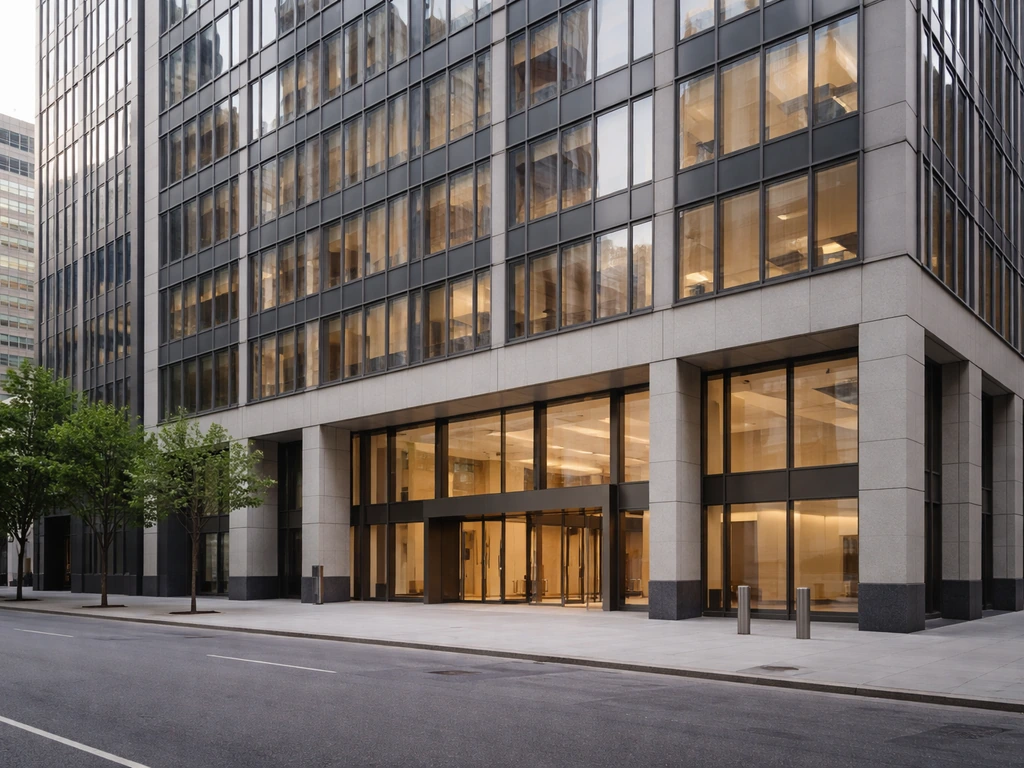
Berman's documented financial footprint runs through several specific entities and properties. The most clearly verified are NB 180 Equity Holdings LLC (identified in a federal court complaint as having Nathan Berman as its sole member), Metro Loft Management, and Leonard Street Properties Group. These entities collectively hold or have held equity in conversion projects at addresses including 180 Water Street, 20 Broad Street, 55 Broad Street, 101 Greenwich, and 675 Third Avenue.
180 Water Street is the most financially visible single asset. It is a large rental residential building in the Financial District that was converted under Metro Loft's sponsorship and secured a $265 million CMBS loan. The building's address for Berman's own operational office is documented as 40 Wall Street, Suite 1706, reinforcing that Metro Loft's day-to-day operations are centered nearby.
Beyond the individual properties, the pattern of repeat institutional financing (from lenders like Northwind Group and others) tells you something about Berman's financial credibility in the market. Institutional lenders do not repeatedly back a sponsor across $90 million, $88 million, and $335 million transactions without strong confidence in his balance sheet and track record. That lender confidence is itself a rough proxy for financial substance, even if it does not translate into a disclosed personal number.
Unlike entertainers whose wealth comes from visible income streams, for example Hannibal Buress, a comedian with documented performance and media earnings, Berman's wealth is embedded in private equity ownership of real property. That makes it harder to calculate precisely but also generally more durable once the assets are stabilized.
Debts, Liabilities, and How They Complicate the Picture
This is the most important section for understanding why the net worth estimate is a range rather than a single number. Real estate developers at Berman's scale carry significant debt as a structural feature of the business. Every conversion project is financed with a combination of equity and debt, and the debt sits on the asset, not necessarily on Berman personally. However, when a loan defaults or enters special servicing, personal guarantees and sponsorship obligations can create real personal liability.
The 180 Water Street situation is the biggest documented liability event. By late 2024, the $265 million CMBS loan secured by the property was at risk of transferring to special servicing due to a maturity default. In April 2025, a $265 million pre-foreclosure action was filed. A federal court complaint also named Berman personally through his NB 180 Equity Holdings LLC ownership. By August 2025, the Wells Fargo v. 180 Water LLC case was voluntarily dismissed without prejudice, which suggests the recapitalization ultimately resolved the immediate crisis, but the dismissal was without prejudice, meaning the risk did not fully disappear.
A separate New York case, Marko Construction LLC v. Berman, involving Liza and Nathan Berman and Metro Loft-related entities, was decided in 2026. The full damages in that case are not publicly summarized in available sources, but its existence as a live litigation adds a layer of unresolved financial exposure that any net worth estimate must account for.
The practical effect: if you take a headline asset valuation for Metro Loft's portfolio and subtract outstanding debt obligations plus potential litigation exposure, the personal net worth figure compresses significantly relative to the gross asset value. This is why the $200 million to $500 million range is wide. The lower bound reflects a scenario where leverage and liabilities are weighted heavily; the upper bound reflects a scenario where the portfolio is performing well and debt is manageable relative to asset values.
Why Different Sites Show Different Numbers

If you have searched for Nathan Berman's net worth across multiple websites, you have probably seen figures that vary widely or that appear with no sourcing at all. There are a few reasons for this.
First, many net worth aggregator sites pull from each other rather than from primary sources. A number gets published on one site, gets scraped by another, and eventually it circulates as if it were verified. For private real estate developers like Berman, where there is no public equity stake or disclosed salary, those numbers are often just guesses repeated at scale. Second, some sites confuse the Metro Loft Nathan Berman with other people sharing the same name, including the HPS Investment Partners associate described earlier. Third, methodology varies: some sites count gross asset values (before debt), some attempt to subtract leverage, and some simply apply a revenue multiple to estimated annual income without knowing the actual leverage structure. A developer controlling $500 million in gross assets might have a personal net worth anywhere from $50 million to $300 million depending on how much of that is financed.
This kind of methodological variation is not unique to Berman. Even well-documented figures face similar estimation gaps. Consider how profiles of someone like comedian Nate Bargatze or actor Nathaniel Buzolic can show different estimates across sites, even though their income is more visible. For private real estate, the uncertainty is compounded because there are no earnings releases, no public stock prices, and no mandatory disclosures.
The most honest thing any reference site can say about Nathan Berman's net worth is this: the number is an informed estimate built from transaction-level evidence, and it should be treated as a range with meaningful uncertainty rather than a precise figure.
How to Verify and Stay Current on This Estimate
If you want to do your own due diligence on Nathan Berman's financial position, there are practical places to look. For transaction-level data, PincusCo and The Real Deal people pages aggregate New York real estate deals, court filings, and loan data tied to specific entities. These are the closest thing to a real-time financial dashboard for private NYC developers. For litigation, Justia and the federal PACER system contain docket-level information on lawsuits involving Berman's entities.
For corporate ownership, the New York State Division of Corporations maintains public filings for entities like Leonard Street Properties Group, Ltd., which you can search by entity name to confirm active status and filing dates. The SEC's EDGAR database contains mortgage trust documents that name Berman as a sponsor or guarantor in specific transactions, which is useful for tying him to financing vehicles with documented dollar amounts.
Commercial Observer and Bisnow are the two trade publications that most consistently cover Metro Loft deals with dollar amounts and deal context. Searching those outlets for "Nathan Berman" or "Metro Loft" will surface the most current financing and acquisition activity, which is the best proxy available for tracking wealth trajectory over time. As of April 2026, the most recent significant data points are the $88 million 101 Greenwich loan (January 2026) and the resolution of the 180 Water Street recapitalization ($335 million), both of which suggest Berman remains active and institutionally credible despite the 2024 to 2025 stress period.
One more note on staying current: net worth estimates for private real estate developers can shift materially in a short window. A completed asset sale, a new joint venture, or a large legal settlement can move the needle by tens of millions of dollars in either direction. Setting a Google Alert for "Nathan Berman" or "Metro Loft Management" is the simplest way to catch new developments as they happen. When major events occur, recalibrate against the same framework used here: documented assets, documented debt, and known litigation exposure.
For readers who enjoy comparing wealth profiles across different career paths, it is worth noting how different Berman's wealth-building model is from, say, Nate Barger or Nathan Buzza, whose financial profiles are built on entirely different industries and income structures. Real estate conversion at Berman's scale is a high-leverage, high-risk, high-reward model: the upside can be enormous over a long hold period, but the liabilities are also significant and visible in ways that entertainers' or media figures' debts typically are not.
Finally, if you are curious how local or regional wealth compares to Berman's New York-based profile, profiles like Neil Bortz in Cincinnati offer an interesting contrast in scale and market context. National real estate markets vary enormously, and a developer operating at Berman's volume in Manhattan occupies a different financial tier than most regional counterparts.