
As of April 2026, Peter Burling's estimated net worth sits somewhere in the range of $3 million to $5 million, with the most defensible middle estimate landing around $3 to $4 million. The lower end comes from algorithmic trackers like PeopleAI, which put him at roughly $3.3 million for 2026. The upper end comes from celebrity biography sites citing $5 million. A figure of $10 million floating around on some aggregator sites is almost certainly inflated and lacks any traceable methodology. None of these are verified bank-balance figures, they are estimates built from career earnings, sponsorship exposure, and publicly known income signals.
Peter Burling Net Worth: Estimate, Income Sources, and How to Verify

Marcus Voss
27 Apr 2026

Who Peter Burling is and why people look up his wealth

Peter Burling is a New Zealand sailor born on January 1, 1991, in Tauranga. He is best known as the helmsman for Emirates Team New Zealand, the syndicate that won the America's Cup in 2017, 2021, and 2024, making him a three-time America's Cup winner. He also won Olympic gold at Rio 2016 in the 49er class alongside his longtime sailing partner Blair Tuke, adding silver and bronze medals from other Olympic campaigns to his record. He competed in the 2017-18 Volvo Ocean Race with Team Brunel and was a founding figure of the New Zealand SailGP team. As of early 2026, he has confirmed a move to sail with Luna Rossa's team for the next America's Cup cycle, a significant career transition.
People search for his net worth because winning the America's Cup three times, earning an Olympic gold medal, and being the face of one of sailing's most commercially visible teams naturally raises the question: what does elite sailing actually pay? Sailing is not a sport where prize money and salaries are regularly published, so the curiosity is understandable. It is also worth noting there is no other widely known public figure named Peter Burling who would cause confusion, the sailor is the person people are looking for.
The net worth estimate: what the numbers actually mean
Across the sources that have published figures, there is a wide range. Here is how they compare:
| Source | Estimate | Methodology Transparency |
|---|---|---|
| PeopleAI (2026) | $3.3 million | Algorithmic, social/career factors — explicitly flagged as guidance only |
| Celebrity-Birthdays.com | $5 million | Described as 'our analysis' of Wikipedia/Forbes/Business Insider — no primary documents |
| RepeatReplay (2025) | $10 million | No calculable model or primary financial documentation provided |
The most honest read is that $3 to $5 million is a plausible range for someone with Burling's career profile, and that any figure above $5 million would need documented evidence, property holdings, disclosed contracts, or investment records, that simply does not appear in any publicly available source. The $10 million figure looks like an aggregator inflating numbers without cross-checking. When PeopleAI itself flags its own estimate as approximate and based on indirect factors, that is the kind of transparency worth respecting.
Where his money actually comes from

America's Cup contracts and team salary
The America's Cup is not a prize-money-for-individuals sport in the same way golf or tennis is. Sailors on professional syndicates like Emirates Team New Zealand are typically paid by the syndicate under contract. The team's budget is funded by commercial sponsors, government support, and the broader campaign structure. As helmsman and one of the team's most prominent figures, Burling would have been at the higher end of that salary range, but specific contract values are not publicly disclosed. His three wins (2017, 2021, 2024) track with three separate campaign cycles, each likely involving a multi-year contract.
SailGP income
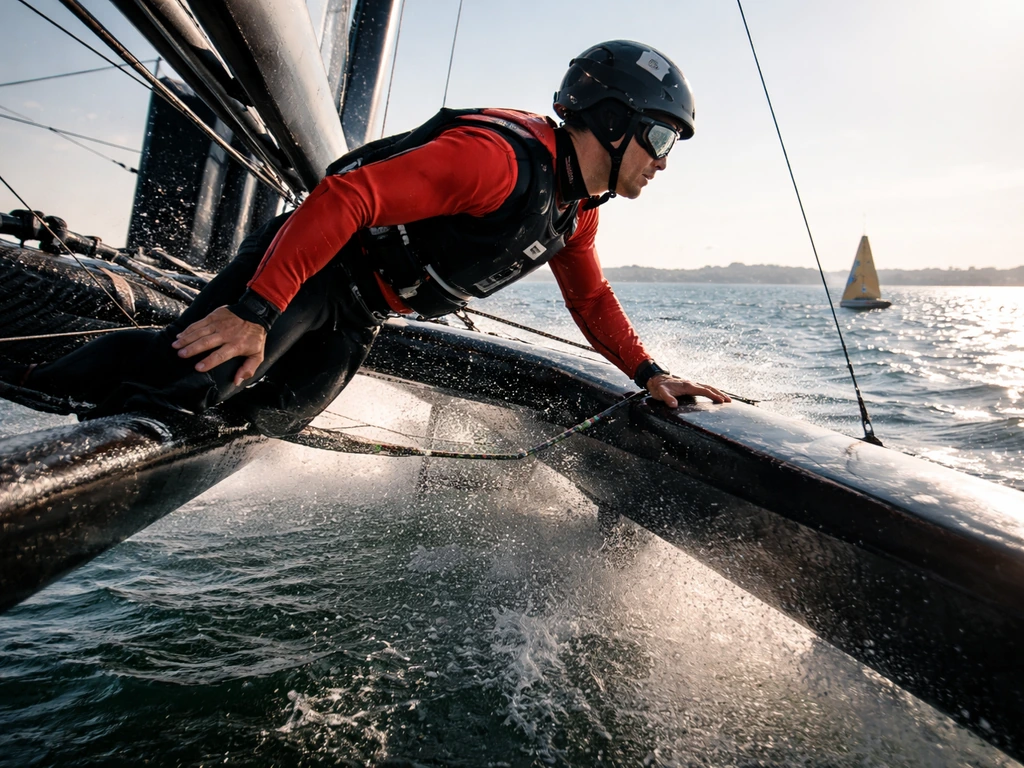
Burling co-founded and drove the New Zealand Black Foils team in SailGP alongside Blair Tuke. SailGP is a commercially structured league with prize money and team ownership models. Drivers and team principals in SailGP can have financial stakes in their team's commercial success, and the league's prize fund has grown significantly since its launch. Specific earnings figures from SailGP are not publicly itemized per driver, but participation at this level consistently supports both income and sponsorship leverage.
Sponsorships and endorsements
Olympic gold and three America's Cup wins make Burling one of the most credentialed sailors alive, which translates directly into endorsement value. Emirates has been the naming sponsor of Emirates Team New Zealand since 2004 and has renewed the partnership multiple times, giving Burling significant brand exposure at the highest commercial level of the sport. Machineryhouse is among the team's official sponsors. At the individual level, Burling's specific personal endorsement contracts are not publicly documented, but athletes at his profile level in sailing typically earn from equipment brands, apparel, and lifestyle sponsors. His transition to Luna Rossa in 2026 may shift some of those alignments.
Offshore and other racing
Burling competed in the 2017-18 Volvo Ocean Race with Team Brunel, one of the world's most demanding offshore races. He also took line honours at the 2025 Rolex Fastnet Race, a prestigious offshore event with prize categories. These campaigns add income and sponsorship value, though individual earnings from offshore participation are rarely disclosed publicly.
Assets and wealth drivers: what is and is not documented
There is no publicly available documentation of Peter Burling's property holdings, investment portfolio, or business ownership stakes. No property registry data, financial filings, or confirmed investment records appear in any credible public source. This is common for athletes of his stature who are not based in jurisdictions that require public asset disclosure and who are not prominent enough in the business world to appear on rich-list publications like the Australian Financial Review Rich List. That absence of documentation does not mean assets do not exist, it simply means any claims about specific properties or investments would be speculation, and this article will not make them.
How his net worth has shifted over his career
Burling's financial trajectory can be mapped against his major career milestones, even without precise income figures at each stage:
- Pre-2016 (Youth and development sailing): Multiple world championship wins in the 420 and 49er classes built his reputation, but income from this period would have been modest — primarily national team funding, development grants, and early sponsorships.
- 2016 Rio Olympics gold: Winning Olympic gold with Blair Tuke dramatically increased his sponsorship value and public profile, making him one of New Zealand's most recognizable athletes.
- 2017 America's Cup win: Serving as helmsman for the winning syndicate is the kind of milestone that justifies significantly higher contract terms for subsequent campaigns. It also cemented his global sailing reputation.
- 2017-18 Volvo Ocean Race: A high-profile offshore campaign that extended his reach beyond the match-racing world and added endorsement exposure.
- 2019 onward (SailGP launch): Participation in SailGP as a co-founder and driver of the New Zealand team added a commercial league income stream alongside the America's Cup cycle.
- 2021 America's Cup win: A second consecutive defense as helmsman reinforced his status and likely supported contract renegotiation upward.
- 2024 America's Cup win: A third win is an extraordinary achievement that further cements endorsement leverage.
- 2025-2026 transition (ETNZ departure, Luna Rossa confirmation): Parting ways with Emirates Team New Zealand and joining Luna Rossa for the next America's Cup cycle is a significant shift. New team, new sponsor alignment, and potentially different contract structure. This is the most relevant near-term variable for his net worth trajectory.
PeopleAI's year-by-year estimates show a consistent upward trajectory: $2.64 million (2024), $2.97 million (2025), $3.3 million (2026). Whether that growth continues or accelerates will depend largely on how the Luna Rossa contract is structured and whether SailGP income continues.
How to verify or challenge the estimate yourself

If you want to stress-test the numbers rather than just accept an aggregator's figure, here is how to approach it practically:
- Check SailGP's official communications for any disclosed prize fund or team revenue data — the league is more commercially transparent than the America's Cup.
- Look at Emirates Team New Zealand's official site and America's Cup coverage for any disclosed sponsorship values or campaign budgets, which give a floor for understanding what athletes in those campaigns can earn.
- Search Reuters, Stuff NZ, and New Zealand Herald for Burling-specific contract or earnings reporting — New Zealand sports journalists have covered him extensively and occasionally report on commercial deals.
- Review World Sailing and Olympedia records to confirm identity and career results, which underpin any income estimation by establishing the credibility of his competitive record.
- Treat any figure from sites that do not show a documented methodology (income + assets + estimated savings rate) as a rough range, not a fact.
- Note publication dates: estimates from 2023 or earlier will not account for the 2024 America's Cup win or the 2025-26 team transition.
The honest limitation here is that sailing salaries are not publicly disclosed the way NFL contracts or golf prize money are. Even the best estimate is built on inference: career longevity, level of competition, sponsorship market rates for equivalent athletes, and publicly visible commercial partnerships. There is no primary document that settles the number.
Common misconceptions worth clearing up
Net worth is not the same as salary
Net worth is an accumulated figure: career earnings minus taxes and living expenses, plus whatever assets remain. A sailor earning a strong salary over 15 years does not have all of that in the bank. Net worth reflects what is left and what has been built, not annual income. Burling's annual income from a combination of contract salary, SailGP, and endorsements is almost certainly higher than any single-year slice of his net worth would imply.
He is not in the same wealth tier as America's Cup syndicate owners
America's Cup campaigns cost tens to hundreds of millions of dollars to run. The syndicate owners and backers are often ultra-high-net-worth individuals. Burling is a professional athlete and sailor, not a syndicate financier. His wealth profile is that of a top-tier professional athlete, not a billionaire sports investor. Conflating the team's budget with an athlete's personal net worth is a common error on aggregator sites.
The $10 million figure is an outlier, not a consensus
The $10 million estimate from RepeatReplay sits well above every other published figure and is not supported by any documented income or asset model. It is the kind of number that appears when sites estimate upward without cross-checking against comparable athletes or the known economics of the sport. Until a credible financial publication or verified primary source supports a figure that high, it should be treated as an outlier.
Sailing prize money is not straightforward
Unlike tennis or golf, sailing's major events do not always distribute large individual prize checks. The America's Cup is a team competition with budgets managed at the syndicate level. The Volvo Ocean Race (now The Ocean Race) distributes prizes but at levels far below the campaign costs involved. SailGP has more transparent prize structures. This means Burling's earnings are driven far more by contracts and endorsements than by direct prize money.
The bottom line on Peter Burling's net worth
A $3 to $5 million net worth estimate for Peter Burling is reasonable and defensible given what is publicly known about his career. He is one of the most decorated sailors of his generation, with a commercial profile that supports meaningful sponsorship and endorsement income alongside his professional contracts. The estimate is not verified by primary financial documents because none exist in the public domain. His 2025-26 transition from Emirates Team New Zealand to Luna Rossa is the most significant recent development that could shift the trajectory, either up or down depending on contract terms. For anyone researching his financial profile, $3 to $5 million is the honest range to work with, and anything much above that requires evidence that does not currently exist publicly. That said, this article is about Peter Burling, not Peter Babej, so Babej's net worth would need separate, source-based verification peter babej net worth. This estimate is also discussed in detail as part of the wider conversation around Peter Chan Bonsai net worth. If you are also comparing related wealth figures in sailing and sports investing, you can look up pete banaszak net worth for context.
FAQ
Why do net worth sites disagree so much on Peter Burling’s number?
Most sites use inference from visible career milestones, sponsorship exposure, and comparable athlete rates, then apply different assumptions about contract size and endorsement strength. If a site lacks a documented asset model, small changes in those assumptions can swing the estimate by millions, which is why you see ranges like $3 to $5 million alongside outliers.
What would count as “proof” that Peter Burling is worth more than $5 million?
Real proof usually means primary documentation, such as disclosed asset holdings, verified business ownership, or credible reporting that quotes specific contract terms and investment income. Without that, any figure above the typical range remains speculative, especially because sailing syndicate budgets are not the same thing as an athlete’s personal assets.
How can I verify whether a high estimate like $10 million is exaggerated?
Check whether the site explains its methodology (what income sources are used, what tax and expense assumptions are applied, and how endorsement income is modeled). Then compare the implied annual earnings to what similar top-tier sailors are known to earn from contracts and sponsorships. If the model has no cross-checkable inputs, treat it as an outlier.
Could his move to Luna Rossa change his net worth estimate right away?
It could change the direction of the estimate over time, but not instantly. Net worth is accumulated, so even if a new contract is higher, you would typically see reflected changes over multiple years, after endorsement realignment and after living expenses and taxes. Look for credible reporting of contract structure first, not just the team change.
Does winning the America’s Cup directly translate into big personal prize money?
Usually not in the way people expect. The America’s Cup is run through syndicates, with earnings and pay structured primarily through contracts funded by sponsors and campaign budgets. That means an athlete’s net worth is driven more by salary and endorsements than by receiving a large individual prize check.
Are SailGP driver earnings likely included accurately in net worth estimates?
Often partially. SailGP has more transparent prize and commercial mechanics than some other sailing categories, but individual driver income is not typically itemized publicly. As a result, net worth sites may capture only indirect effects like prize exposure, bonuses, and sponsorship leverage rather than exact payments.
What’s the most common mistake when estimating Peter Burling’s wealth?
Confusing team or campaign money with the athlete’s personal net worth. Many inflated numbers appear when someone assumes the syndicate’s budget or the broader economics of a campaign are directly “his money,” instead of modeling his personal contract and endorsement income net of expenses, taxes, and any financial obligations.
Where can I look for evidence of endorsements without relying on net worth trackers?
Focus on whether brand partnerships are publicly visible and sustained (naming sponsor renewals, official equipment apparel deals, and major campaigns that show recurring athlete branding). Even then, you often cannot get exact contract values, but consistent sponsorship presence helps you judge whether endorsement income assumptions are reasonable.
Could he have investments or property even if nothing is publicly documented?
Yes, lack of public filings does not prove absence of assets. However, without jurisdiction-specific disclosures or credible reporting, you cannot responsibly assign values to property or investments. Net worth estimates should stay within ranges that can be supported by career income inference unless primary evidence appears.
Why is the article confident about a $3 to $5 million range but not a precise figure?
Because sailing salaries, contract details, and many endorsement terms are not publicly disclosed at the level needed for exact calculation. The best-supported approach is to use a bounded range based on career duration, competitive level, sponsorship visibility, and the economics of comparable professional athletes.
Next Articles

Steven Bancarz Net Worth: Estimate, Income Sources, and How to Verify
Steven Bancarz net worth estimate explained with income sources, wealth signals to verify, and accuracy limits.

Steven Basalari Net Worth Estimate Explained and Verified
Steven Basalari net worth estimate with verified sources, defensible range, and a checklist to confirm updates.

Stephen Budd Net Worth: Estimate, Sources, and How to Verify
Stephen Budd net worth estimate with sources, income drivers, and a checklist to verify figures from public records.