
As of April 10, 2026, a defensible estimated range for Gavin Uberti's net worth is roughly $50 million to $250 million. That wide band reflects the reality that blank" rel="noopener noreferrer">Etched, the AI chip startup he co-founded and leads as CEO, is a private company, so there are no audited financials, no SEC disclosures, and no public share price to anchor a precise figure. What we do have are credible funding data points, a reported $5 billion valuation from early 2026, and standard methodology for backing out a founder's approximate stake value. Everything below explains how that range was constructed, what could move it up or down, and exactly how to track it yourself.
Gavin Uberti Net Worth: Estimate, Sources, and How to Verify

Marcus Voss
10 Apr 2026

Who Gavin Uberti is
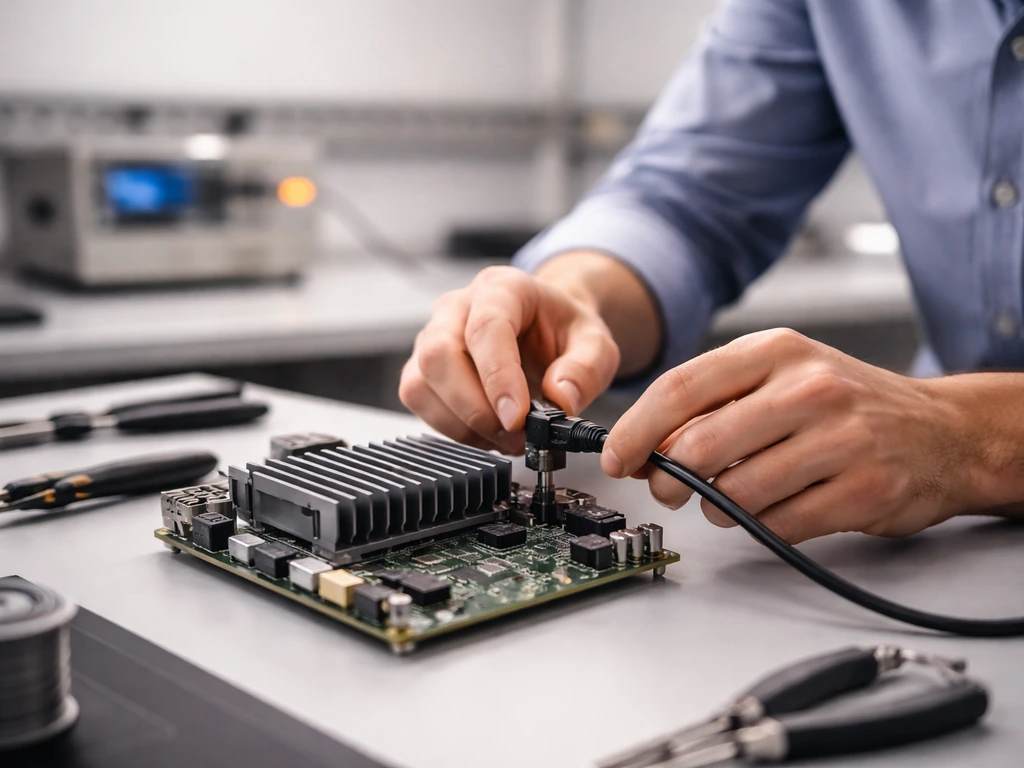
Gavin Uberti is the Co-Founder and CEO of Etched, an AI hardware company based in San Francisco. He co-founded the company in 2022 alongside Chris Zhu and Robert Wachen. Etched's specific bet is that the transformer architecture has become dominant enough in AI to justify building application-specific integrated circuits (ASICs) designed exclusively for transformer workloads, rather than the general-purpose GPUs or broader-purpose AI chips that most of the industry relies on. The pitch is straightforward: strip out everything a transformer doesn't need and gain order-of-magnitude improvements in inference throughput.
Before starting Etched, Uberti worked at OctoML, where he built compilers, including matrix multiplication kernels for the Apache TVM compiler. He also led development of a Cortex-M convolution kernel that achieved state-of-the-art results on the MLPerf Tiny benchmark. That background is relevant to the net-worth picture because it tells you he was a working engineer, not a serial entrepreneur or someone who had already had a lucrative exit. His wealth story is almost entirely tied to Etched.
One quick disambiguation note: there is no widely publicized person named Gavin Uberti outside of this context. The name is uncommon enough that if you landed here after a search, you almost certainly have the right person. He is not a celebrity, not a professional athlete, and not a media personality. His public profile comes entirely from the AI chip industry.
Why pinning down his net worth is genuinely difficult
Etched is a private company. That single fact is the core reason any number you see attached to Uberti's name is an estimate, not a verified figure. Private companies are not required to file financial statements with the SEC, do not publish quarterly earnings, and do not trade on a public exchange with a live share price. There is no equivalent of a Form 4 or proxy statement where you can read off a CEO's compensation and equity holdings.
The established methodologies for estimating private-company wealth, including approaches used by outlets like Forbes and Bloomberg, involve pairing a company's estimated revenue or EBITDA against valuation multiples from comparable public companies, then applying a liquidity discount because private shares can't be instantly sold. Even that approach requires knowing a founder's ownership percentage after multiple funding rounds, which is also private. Forbes has said publicly that its methodology for private businesses is deliberately conservative and treats estimates as at-least figures, not precise valuations. Bloomberg's Billionaires Index uses enterprise value-to-EBITDA or price-to-earnings comparisons for closely held companies. Neither methodology applies cleanly here because Etched is pre-revenue at scale and founder dilution data isn't public.
A secondary challenge is that most "net worth" aggregator sites do not disclose their methodology. Sites like Wealthy Gorilla compile numbers from a wide variety of sources, and the confidence level behind a figure for a private startup CEO is very different from a figure for, say, a musician with decades of public record label contracts and real estate filings. Always ask where a number comes from before treating it as fact.
The current net worth estimate and what drives it

Here is the reasoning behind the $50 million to $250 million range. In early 2026, Datacenter Dynamics reported that Etched raised $500 million at a $5 billion valuation. Combined with the $120 million Series A Etched raised in 2024 (reported by CNBC), the company has taken in at least $620 million in disclosed funding across multiple rounds. At a $5 billion valuation, a co-founder who retained even 5 percent of the company after dilution would hold paper equity worth $250 million. If dilution was heavier, as is common after a large growth round, a 1 to 2 percent stake would land between $50 million and $100 million.
The key assumptions are: (1) the $5 billion valuation is accurate as reported, (2) Uberti holds somewhere between 1 and 5 percent of the company post-dilution, (3) a standard liquidity discount of 20 to 40 percent applies because the shares are not publicly tradeable, and (4) any personal cash savings, prior compensation from OctoML, or other assets are relatively minor additions compared to the equity figure. These are reasonable but unverified assumptions. If Etched goes public or is acquired, the real number would become knowable. Until then, treat the range as the honest answer.
Where the money actually comes from
For a private startup CEO of Uberti's profile, wealth accumulates through a specific set of channels. Understanding which channels matter most helps you track the right signals.
- Equity stake in Etched: This is by far the dominant driver. A co-founder who stays CEO through a $5 billion valuation round holds the most valuable asset on their personal balance sheet in the form of illiquid startup equity.
- CEO salary: Private startup CEOs at funded companies typically draw salaries in the $200,000 to $500,000 range at growth-stage companies, sometimes lower at early stages to preserve runway. This contributes to net worth but is not the headline number.
- Prior employment earnings: Uberti's time at OctoML likely produced a standard software engineer or senior researcher salary. OctoML was itself a funded startup that was later acquired by Amazon. Any equity he held there could have produced a modest liquidity event, but there is no public data to confirm this.
- Patents and IP: Uberti is listed as an inventor on a patent assigned to Etched.ai Inc. (granted July 2025, covering tensor operations in AI models). Patents held by a company do not directly translate to personal wealth, but they signal the depth of his technical role and reinforce the equity story.
- Venture secondary sales: Some founders sell a portion of their equity in secondary transactions during large funding rounds. Whether Uberti did this in the 2024 or 2026 rounds is not publicly known.
There are no credible indicators of major personal real estate holdings, public stock portfolios, or external business investments tied to Uberti's name. His wealth profile is concentrated and startup-dependent, which is both a potential upside (if Etched succeeds) and a vulnerability (if the company struggles or the AI chip market shifts).
How to compare wealth-building paths in tech founding
To put Uberti's position in context, it helps to compare it against other tech founders at different stages of their journey. Consider someone like Gary Burrell, whose wealth trajectory unfolded over decades through a publicly traded company (Garmin), creating a very different evidence trail than a private AI startup. Or look at the contrast with operators in asset-heavy industries, such as Gary Berman of Tricon, where real estate portfolios and public filings make wealth estimation far more straightforward. The point is not that Uberti's path is unusual, it is that private tech equity is genuinely opaque until a liquidity event forces transparency.
Public records and credible data you can actually use

Even though Etched is private, several legitimate public records touch on Uberti's business profile. A California business entity filing associates Gavin Joseph Uberti with Etched.ai, Inc. in roles including Secretary, CEO, and acting CFO. This confirms his executive presence and corporate standing but says nothing about compensation or equity percentage. That filing is accessible through California's Secretary of State business search tool.
The USPTO patent database (searchable via Justia Patents) confirms Uberti as an inventor on at least one patent assigned to Etched.ai Inc. That record is public, dated, and primary-source verified. It does not prove net worth, but it does confirm active technical and IP contribution to the company.
Bloomberg's company profile for Etched.ai Inc. lists Uberti as CEO and co-founder. CNBC's coverage of the 2024 Series A and Datacenter Dynamics' 2026 reporting on the $500 million raise are the strongest public data points for valuation. Cross-referencing those two against each other is more reliable than any single aggregator site's figure.
What you will not find in public records: his exact equity percentage, vesting schedule, whether he has sold secondary shares, his base salary, or any personal tax filings. Those are private unless voluntarily disclosed or required by a future IPO filing (an S-1 would contain all of this).
A practical comparison: what makes net worth easier or harder to estimate
| Factor | Public company executive | Private startup CEO (Uberti) |
|---|---|---|
| Share price | Publicly available in real time | Not available; requires valuation round data |
| Equity holdings | Disclosed in SEC filings (Form 4, proxy) | Private; must be estimated from dilution modeling |
| Salary | Disclosed in proxy statement | Not public |
| Funding/valuation | Implicit in market cap | Disclosed only via press releases or leaks |
| Liquidity | Shares can be sold on exchange | Illiquid until IPO, acquisition, or secondary sale |
| Estimate confidence | High (narrow range possible) | Low to medium (wide range required) |
How to research this yourself and stay current

Net worth estimates for private company founders go stale quickly. A new funding round, an acquisition announcement, or a regulatory filing can shift the picture overnight. Here is a checklist of the specific things to track and where to find them.
- Set a Google Alert for 'Etched AI funding' and 'Etched.ai valuation' to catch new round announcements as they are reported.
- Monitor Crunchbase and PitchBook (free tiers available) for Etched's funding history. Each new round will add a post-money valuation and sometimes investor names that can signal the company's trajectory.
- Check the USPTO patent database at patents.google.com or Justia.com for new filings by Gavin Uberti or assigned to Etched.ai Inc. New IP activity signals ongoing R&D investment and can precede product announcements.
- Search the California Secretary of State's business entity database (bizfileSF.sos.ca.gov) for Etched.ai Inc. to catch officer changes or new filings.
- Watch for an S-1 filing on the SEC's EDGAR database. If Etched goes public, that document will disclose Uberti's exact shareholding, compensation history, and vesting terms, making a precise net worth calculation possible for the first time.
- Follow Uberti's LinkedIn activity and any conference appearances (he has spoken at SEMI-affiliated events) for public statements about company milestones that might imply valuation signals.
- Track major AI chip industry news. Etched's valuation is tied to the broader market for transformer inference hardware. Shifts in demand, competitor moves (from Nvidia, AMD, or other ASIC startups), or changes in AI model architecture trends all affect what Etched is worth.
Misconceptions that trip people up in net worth searches
The biggest one: confusing salary with net worth. A CEO earning $400,000 a year does not accumulate $400,000 in net worth annually. After taxes, living expenses, and the fact that most startup equity is illiquid, actual spendable wealth accumulation from salary alone is modest. The real wealth creation for a founder like Uberti happens when equity is liquidated, not when the paycheck clears.
A second common mistake is treating all net worth websites as equivalent. Aggregator sites pull from each other, repeat each other's figures, and rarely document methodology. A number that appears on ten different sites might trace back to a single speculative post from years ago. This is especially true for figures attached to people like Uberti, who is prominent enough to attract curiosity but not prominent enough to have been rigorously covered by Forbes or Bloomberg with their full methodology applied. If you cannot find a primary source for a specific number, treat it as unverified.
Third, people often conflate company valuation with founder net worth. Etched being valued at $5 billion does not mean Uberti is worth $5 billion. Valuation is the price assigned to the entire company in a funding transaction. A founder's stake is a fraction of that, further discounted for illiquidity, and net worth is that stake minus any personal debts. The gap between headline valuation and individual founder wealth is almost always enormous, especially in early-stage companies with multiple rounds of dilution.
Finally, timing matters more than people realize. A net worth estimate published in 2024 (before the $500 million raise was reported) would have been based on very different data than one written today. Always note when a figure was last updated and whether it accounts for the most recent known funding round. That is just as true for well-documented figures, like those for entrepreneurs in adjacent industries such as Gary Bencivenga or Gary Buechler, as it is for a private AI hardware CEO. Wealth figures decay without updates tied to real-world financial events.
Putting the estimate in perspective
The $50 million to $250 million range for Gavin Uberti's net worth as of April 2026 is grounded in real data: a confirmed $5 billion reported valuation, over $620 million in disclosed fundraising, patent filings confirming his active role, and standard founder dilution modeling. It is not a precise figure because no precise figure is publicly verifiable for a private company founder at this stage. If Etched files for an IPO or announces an acquisition, that range will collapse into something much more specific, and the SEC filings will tell you exactly what he is worth to the dollar.
Until then, the honest answer is: somewhere between $50 million and $250 million in illiquid paper equity, with a smaller but real base of liquid assets from salary and any prior employment. That is a meaningful amount of wealth, almost entirely dependent on Etched's continued success, and it will not be precisely knowable until the company reaches a liquidity event. Track the signals listed above, ignore aggregator sites that cite each other in circles, and revisit the estimate whenever a new funding round or strategic announcement comes through. That is the most useful thing you can do with this search today.
For context on how wealth accumulates differently across industries and career types, it is worth comparing founders like Uberti against executives in more asset-driven businesses. Profiles like those of Gary B. Sabin in commercial real estate or Gary Bimonte in their respective fields illustrate how different wealth-building mechanics are across sectors, and why methodology matters as much as the headline figure.
FAQ
How can I estimate Gavin Uberti net worth without knowing his exact equity percentage?
Treat Etched’s valuation as a company-level number, then convert it to an estimated founder stake using an assumed post-dilution ownership range. For a private company, also apply an illiquidity discount and subtract any known personal debts you can verify. If you do not have the ownership percentage or any credible dilution history, the result can easily be off by several multiples.
What ownership range is most plausible for a co-founder at Etched after big funding rounds? (1% to 5% etc.)
You can sanity-check any estimate by asking whether it implies an ownership stake that is realistic for an early-stage co-founder after multiple rounds. Example decision rule: if a figure requires Uberti to own far more than a few percent after a large later round, it is likely overstated. Cross-check against the company being valued at $5B in 2026 and the size of subsequent rounds, because later rounds usually reduce founder percentages.
Could Gavin Uberti net worth be higher than the paper-equity estimate because of secondary share sales?
Yes, secondary sales and pre-IPO transfers can matter even when the company stays private longer than expected. If Uberti sold any shares to employees, accredited buyers, or in tender offers, part of his paper equity would have become liquid cash, increasing net worth beyond a simple valuation-based estimate. Unfortunately, secondary activity is often not public for startups, so you should look for “share sale” or “tender” wording in credible coverage rather than rely on valuation changes alone.
Why does focusing on CEO salary often overstate net worth for founders like Uberti?
Salary can be misleading because net worth grows from savings and investments, not from gross compensation. In practice, startup CEOs often earn a modest base relative to equity value, and taxes plus living expenses reduce what becomes wealth. A useful check is to treat annual compensation as contributing only what is realistically saved after taxes, then focus your estimate on equity events, not income.
How do I tell whether a Gavin Uberti net worth number is copied, outdated, or calculated well?
If you see a net worth number on multiple aggregator sites, it may be copied from the same original source or an earlier speculation. A better approach is to prioritize numbers tied to verifiable inputs, like disclosed funding rounds, reported valuations from credible reporting, and primary records for role and IP. If the site cannot explain how it derived the founder’s stake and the liquidity discount, downgrade confidence.
When should I assume a net worth estimate is out of date, and what events should force a re-check?
A credible update should be triggered by a primary financial event: a priced follow-on round, a merger or acquisition announcement, an IPO filing, or a regulatory event that forces disclosure. Timing matters because estimates can remain unchanged for months while the implied equity value changes quickly after new financings. If a number has not been updated after the latest known funding report, assume it is stale.
Does personal debt meaningfully affect estimated net worth for founders, and can I account for it here?
Debt and personal liabilities can reduce net worth even if paper equity looks large. The article notes that personal debts and liquid asset balances are not publicly verifiable for him, which is why the range stays broad. If you ever find credible information about major loans, mortgages, guarantees, or tax liens, subtract them from the equity-based estimate to adjust the lower bound.
What would change the estimate from a broad range to something close to exact?
If Etched ever files for an IPO, the estimate can become much more precise because you can read equity holdings, option grants, vesting, and sometimes related compensation in SEC filings. Until that happens, the best you can do is model a stake range and apply liquidity assumptions. This is why the range will “collapse” into a number after a liquidity event.
Why can two people with the same net worth headline have very different real financial flexibility?
Yes, the “net worth” label usually assumes assets minus liabilities, but the asset side here is mostly illiquid equity. That means the spendable wealth might be far lower than the implied paper value until there is a liquidity event. When comparing people, separate “paper equity value” from “liquid net worth” to avoid false comparisons.
What is the fastest way to avoid mixing up Gavin Uberti’s wealth with someone else’s or with irrelevant numbers?
Make sure you are estimating Etched-focused wealth rather than generic “AI startup CEO” narratives. The article already disambiguates that the public footprint for Gavin Uberti is primarily tied to Etched, so if you find numbers not connected to disclosed Etched rounds, discount them. Also be cautious of calculations that ignore founder dilution or treat valuation as if it were personal value.
Next Articles

Steven Bancarz Net Worth: Estimate, Income Sources, and How to Verify
Steven Bancarz net worth estimate explained with income sources, wealth signals to verify, and accuracy limits.

Steven Basalari Net Worth Estimate Explained and Verified
Steven Basalari net worth estimate with verified sources, defensible range, and a checklist to confirm updates.

Stephen Budd Net Worth: Estimate, Sources, and How to Verify
Stephen Budd net worth estimate with sources, income drivers, and a checklist to verify figures from public records.